

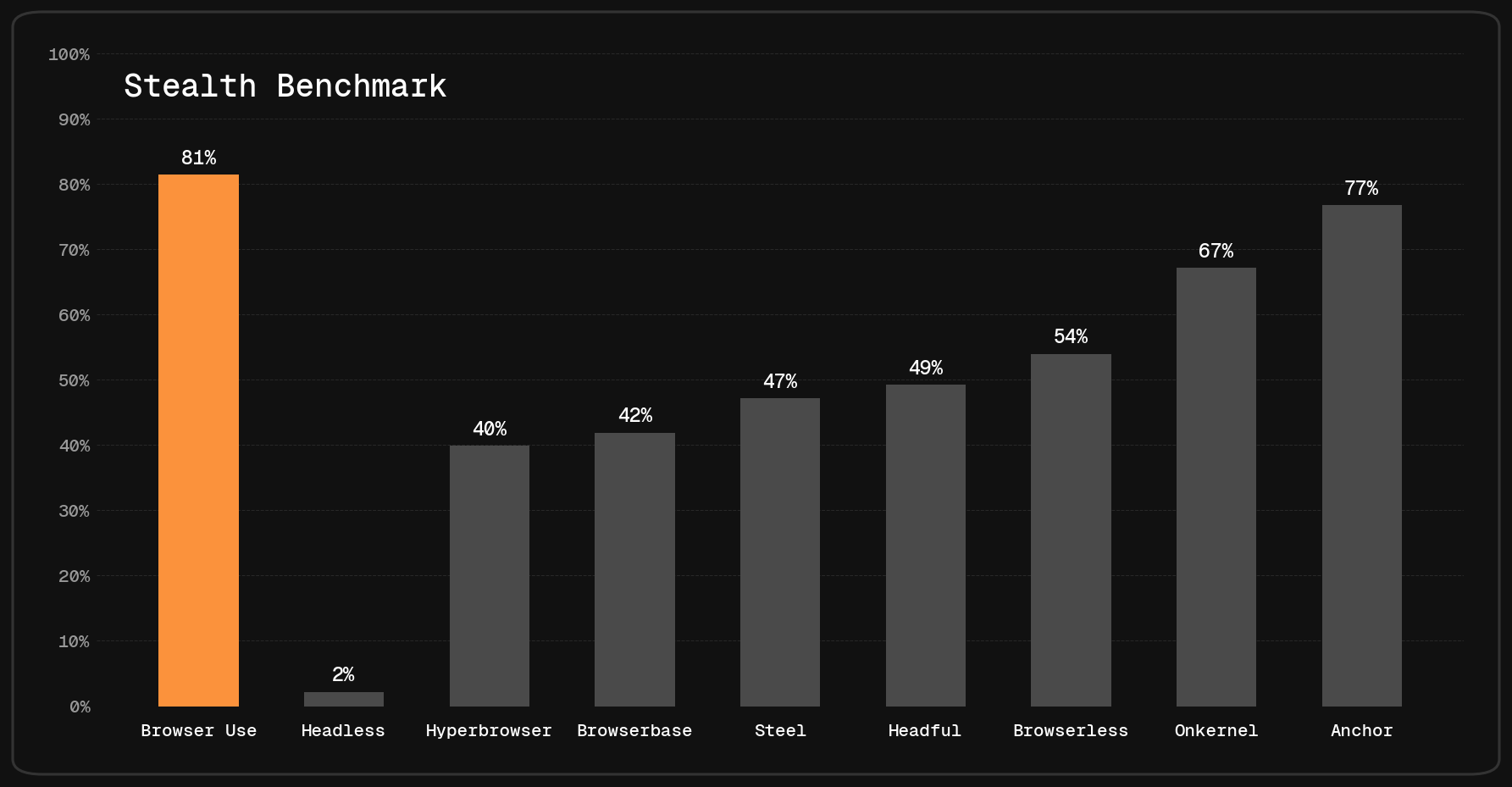
Stealth benchmark — success rate on high-security sites, Browser Use vs other cloud browsers
What’s included
Every cloud browser session runs in a hardened Chromium fork with stealth enabled by default — no configuration needed. Create a browser session and it is already on.- Anti-detect browser fingerprinting — Canvas, WebGL, fonts, navigator, and other browser fingerprints are randomized per session to appear as a real user. Passes CreepJS, BrowserLeaks, and other fingerprint detectors.
- Ad and cookie banner blocking — Banners are dismissed automatically so the agent sees clean pages and executes faster.
- Cloudflare / anti-bot bypass — Works on sites protected by Cloudflare, PerimeterX, and other bot detection services.
Residential proxies
Residential proxies are enabled by default across 195+ countries. This makes browser sessions appear as real users from the target geography. See Proxies for details on geo-targeting and custom proxy configuration.Further reading
- Benchmarks — 84.8% on BrowserBench and 81% bypass on high-security sites, against other providers
- We stealth benchmarked every major cloud browser provider
- Browser agent bot detection is about to change
- Stealth Browser Infrastructure